How Dutch geometry differs from international practice
All four countries use circular junctions, but the geometry, signage and priority rules diverge sharply. The table below summarises the differences for an urban two-lane roundabout.
| Parameter |
Netherlands (CROW) |
Russia (GOST · SP) |
United Kingdom (DMRB) |
Germany (FGSV) |
| Reference standard |
CROW Publication 257 (2008); Handboek Wegontwerp (2017). |
ГОСТ Р 70555-2022 (active since 1 Feb 2023, rural roads); СП 396.1325800.2018 with amendments 1–3 (urban); ОДМ 218.2.071-2016 (methodology, active). ПНСТ 271-2018 expired on 1 Sept 2021. |
DMRB CD 116 (Design of roundabouts). |
FGSV Merkblatt für die Anlage von Kreisverkehren (2006). |
| Priority rule |
Circulating traffic has priority (since 1991, signposted). |
Circulating traffic has priority by default since Decree N 1300 of 26 Oct 2017; confirmed with sign 4.3 (ГОСТ Р 52289-2019). |
Circulating traffic has priority (since 1966, "offside priority rule"). |
Circulating traffic has priority unless signed otherwise. |
| Typical outer diameter |
30–45 m (urban), 45–60 m (rural). |
ГОСТ Р 70555-2022 classifies rural roundabouts into small, medium and large diameter classes; СП 396 §5.8.18 requires a central-island diameter of at least 10 m (1-lane) or 12 m (2-lane). |
28–50 m (compact / normal). |
26–40 m (small "kleiner Kreisverkehr"), up to 60 m for large. |
| Design entry speed |
25–30 km/h, enforced by entry deflection. |
Mandatory entry deflection; speeds enforced through the geometry of the directional island and entry angle (ГОСТ Р 70555-2022, §6.1–6.2). |
≤30 mph (≈48 km/h). |
≤30 km/h. |
| Cyclists |
Concentric cycle ring 5 m offset, with priority inside built-up areas (CROW Ontwerpwijzer Fietsverkeer). |
СП 396 §5.8.17 allows cycle lanes only on single-lane roundabouts; no national equivalent of a concentric ring. |
Mixed; cycle lanes or shared use, no national standard. |
Cycle lane on carriageway or shared crossing with pedestrians. |
| Pedestrians |
Zebra crossings 5 m from yield line on every leg. |
Zebra crossings on each leg, refuge island required where central reservation exists. |
Zebra or signal-controlled crossings on busy sites. |
Zebra crossings, often raised. |
| Turbo / spiral geometry |
Turbo-roundabout strongly preferred over conventional two-lane (CROW Publication 257). |
No active national standard. The cancelled ПНСТ 271-2018 (valid 2018–2021) contained a dedicated Section 13 on "кольцевые пересечения со спиральными полосами движения"; the replacing ГОСТ Р 70555-2022 does not include this geometry. |
Conventional two-lane or signalised "hamburger" roundabouts. |
Conventional two-lane; growing use of turbo geometry since 2005. |
| Use of signals |
Avoided. If volumes require signals, the junction is redesigned. |
Permitted at large-diameter or multi-lane junctions; common on Moscow and Saint Petersburg urban rings. |
Signalised roundabouts widespread on the strategic road network. |
Rare; only at very high-volume sites. |
A field atlas of Dutch roundabouts
Plates V — VIII · Selected examples
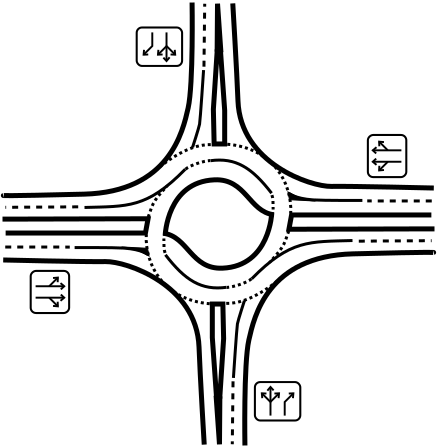
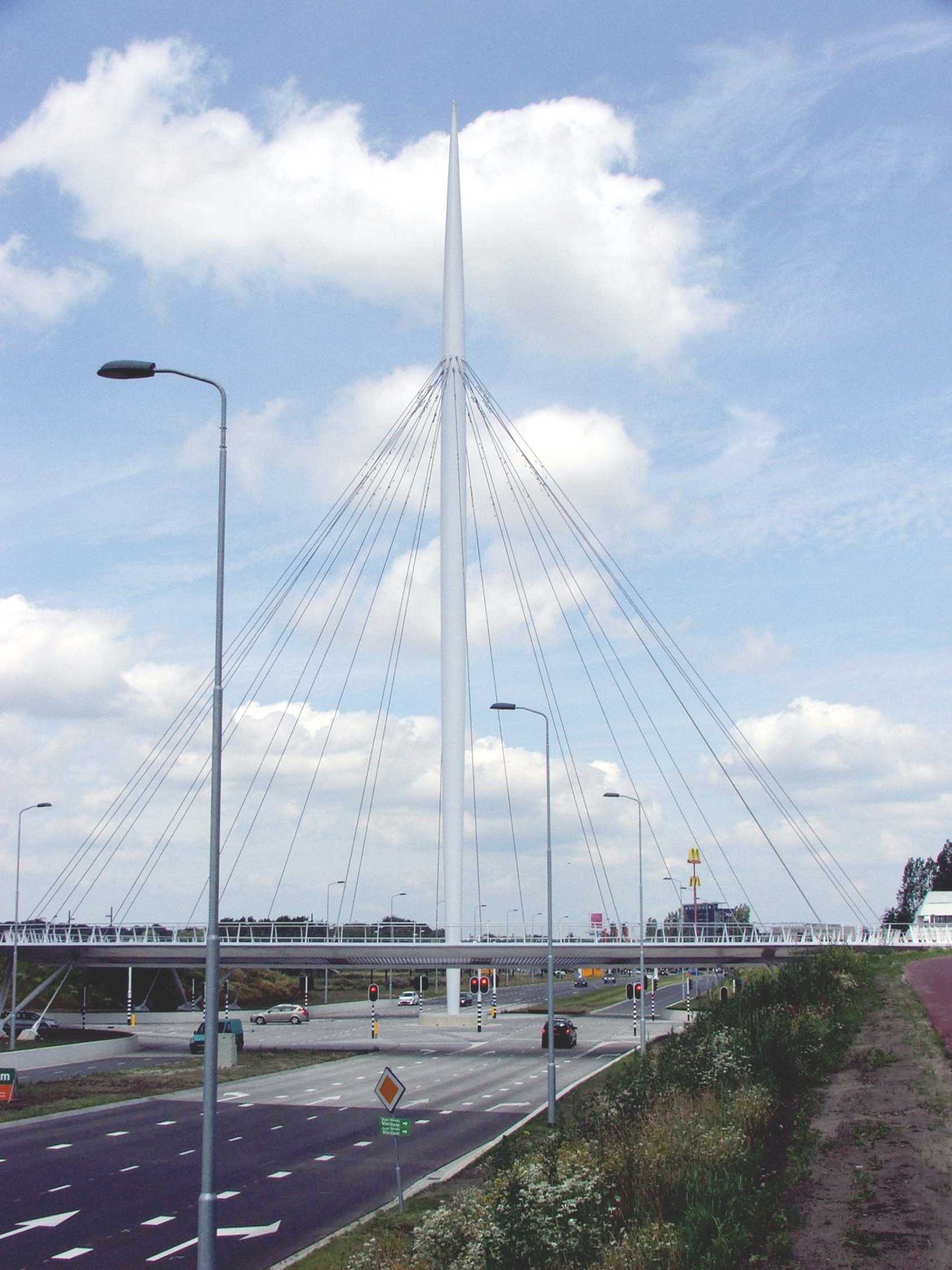
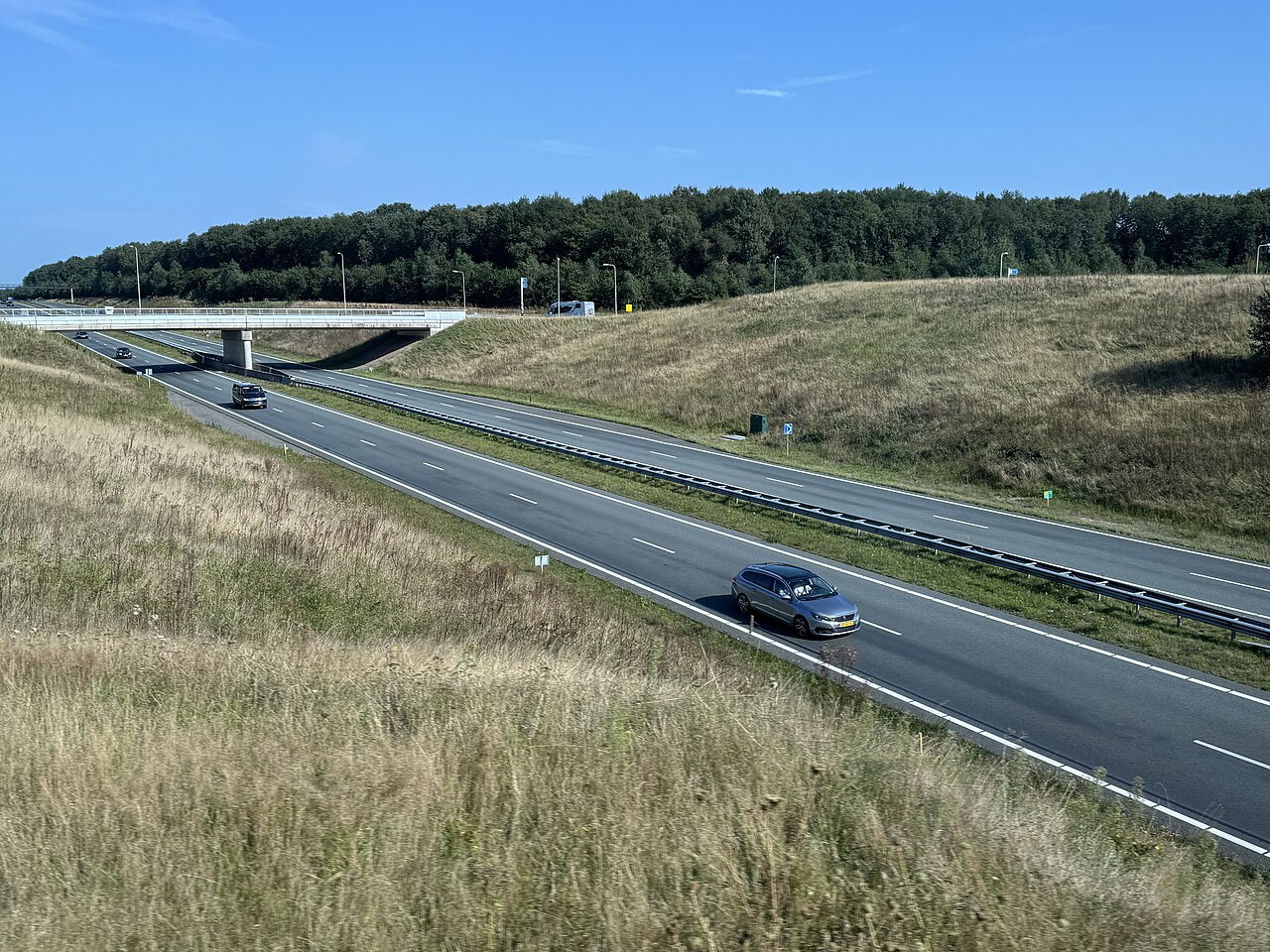
Verkeersplein Gieten — N33 / N34, Drenthe
Sunken interchangeProvincial
Two through-roads pass beneath the ring on the busiest provincial junction in the north — a Dutch alternative to grade-separated cloverleaves.
Photo: Ennomien · Wikimedia · CC BY-SA 4.0
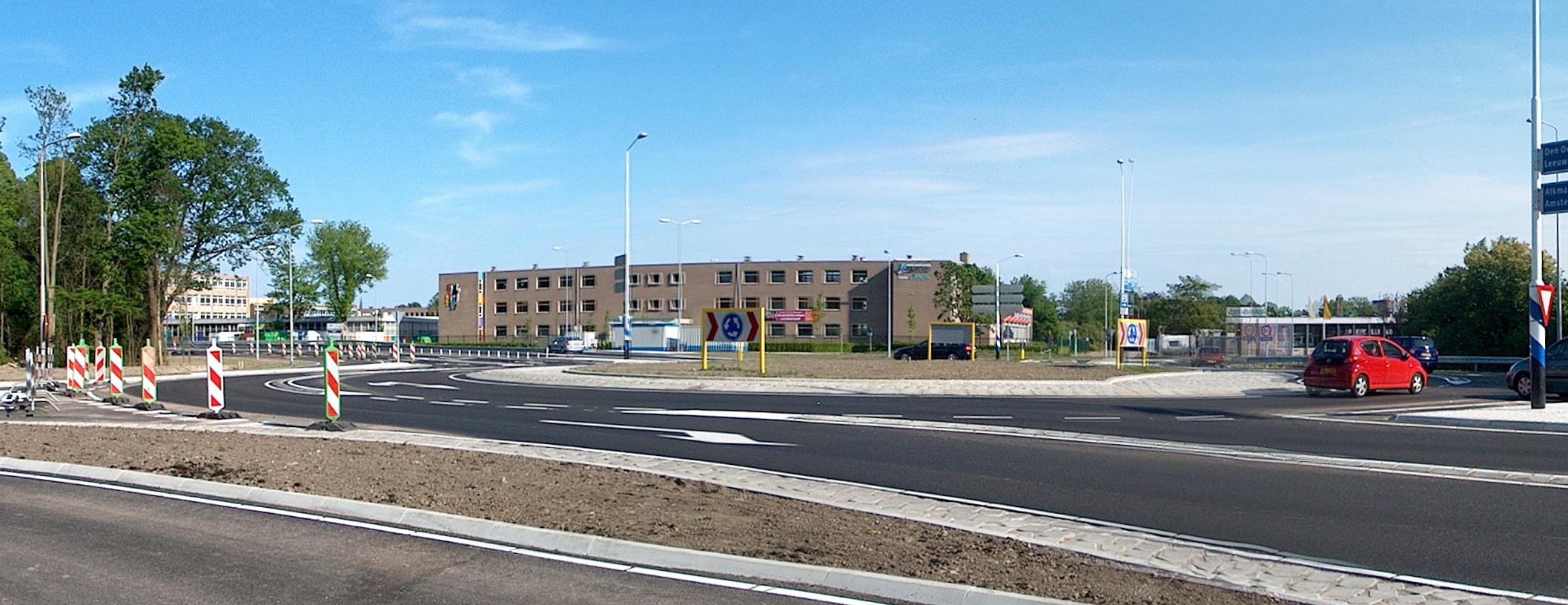
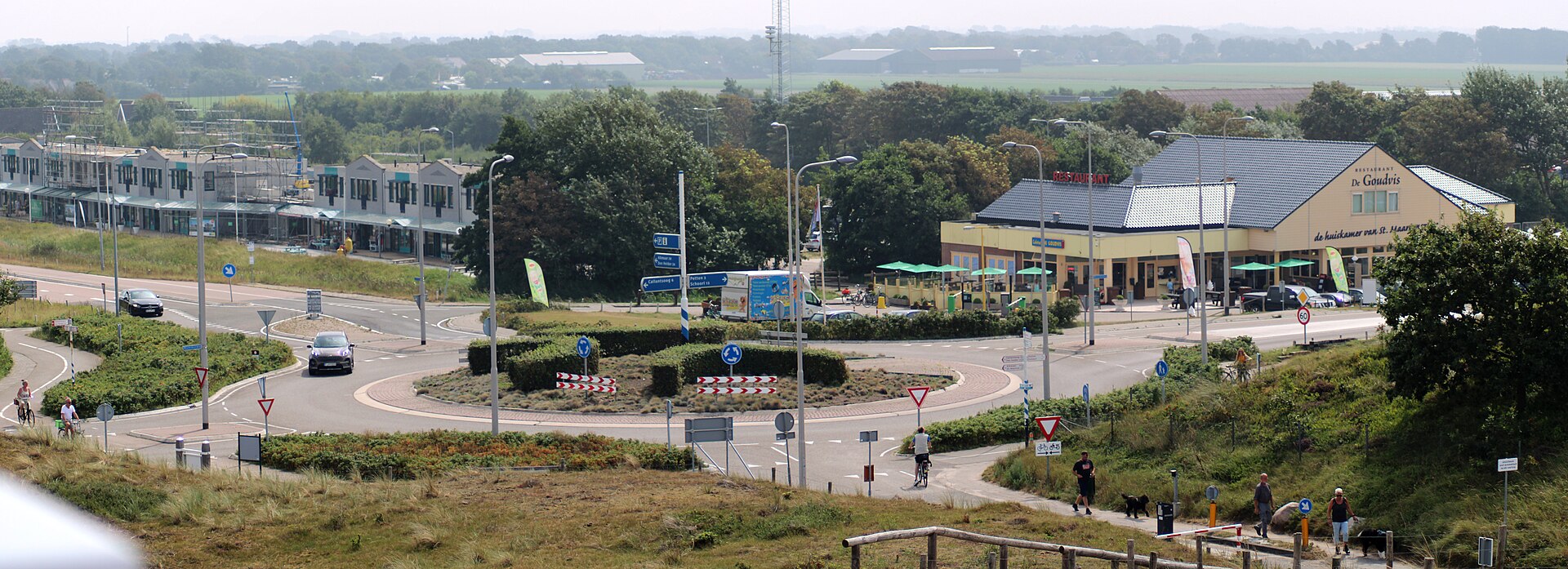
Rural roundabout — near Petten
Rural · 1-lane
Textbook 40 m single-lane geometry on the coast of North Holland.
Photo: Falko Tetzemann · Wikimedia · CC0
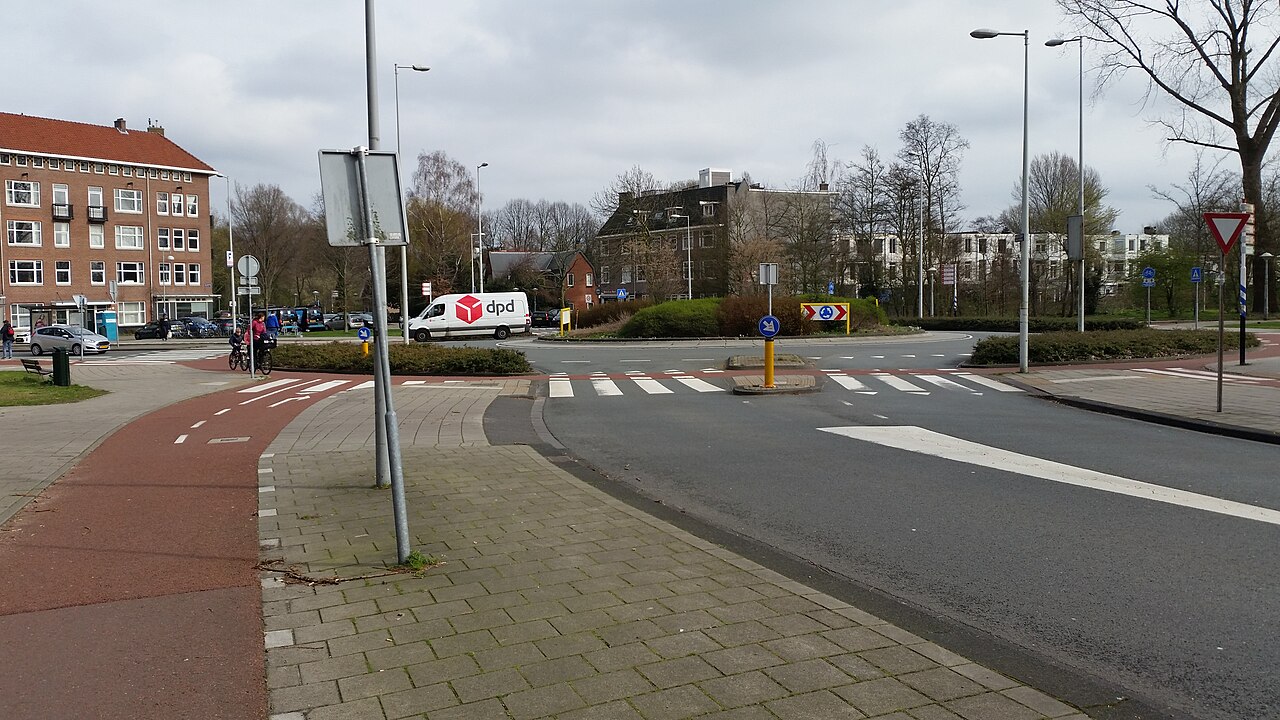
Aalsmeerplein — Amsterdam-Zuid
Concentric cycle ringUrban
The hallmark Dutch urban configuration: a 5 m offset cycle ring with priority on every leg, separating 12,000 daily bicycles from motor traffic.
Photo: Ceescamel · Wikimedia · CC BY-SA 4.0
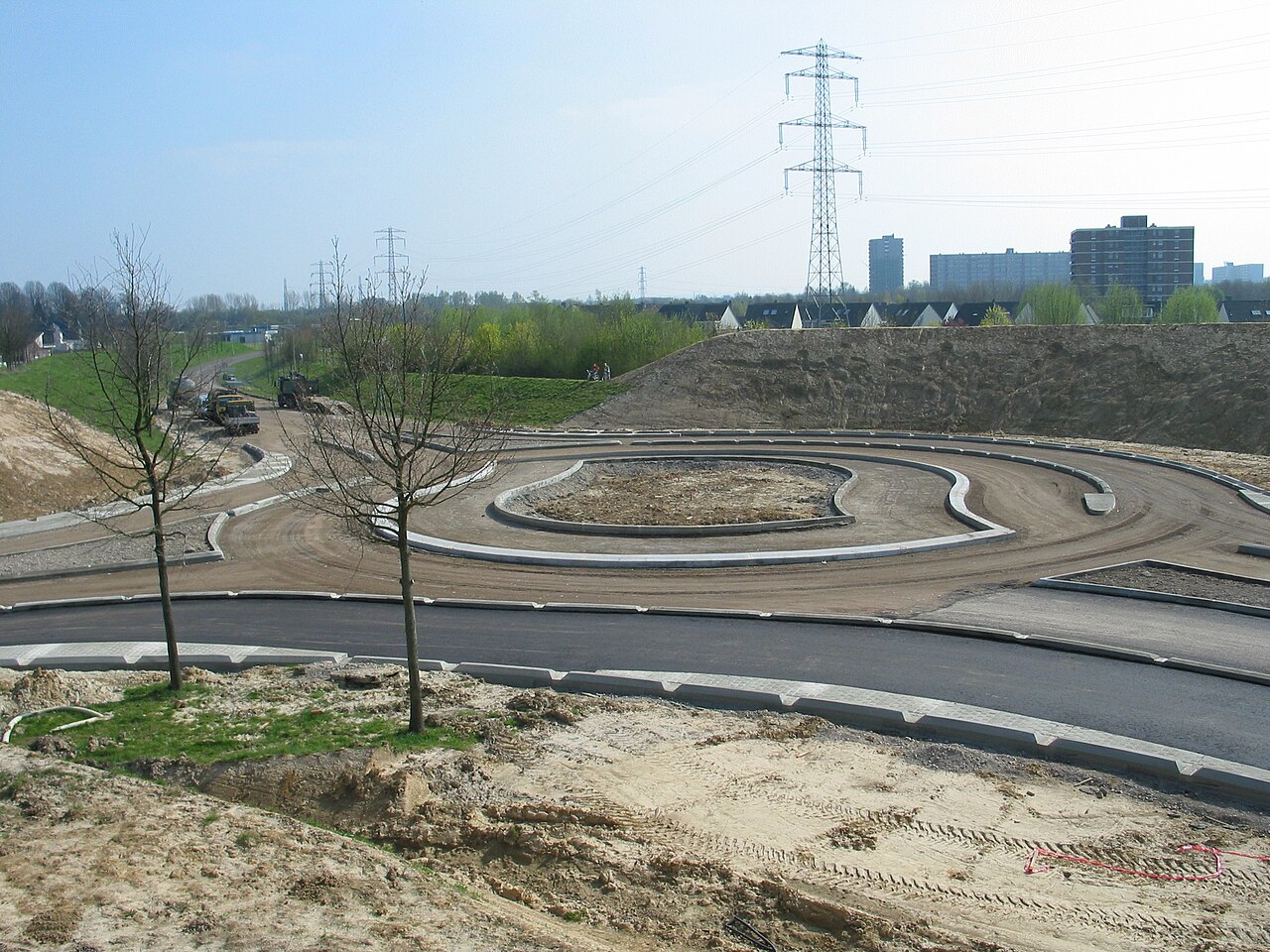
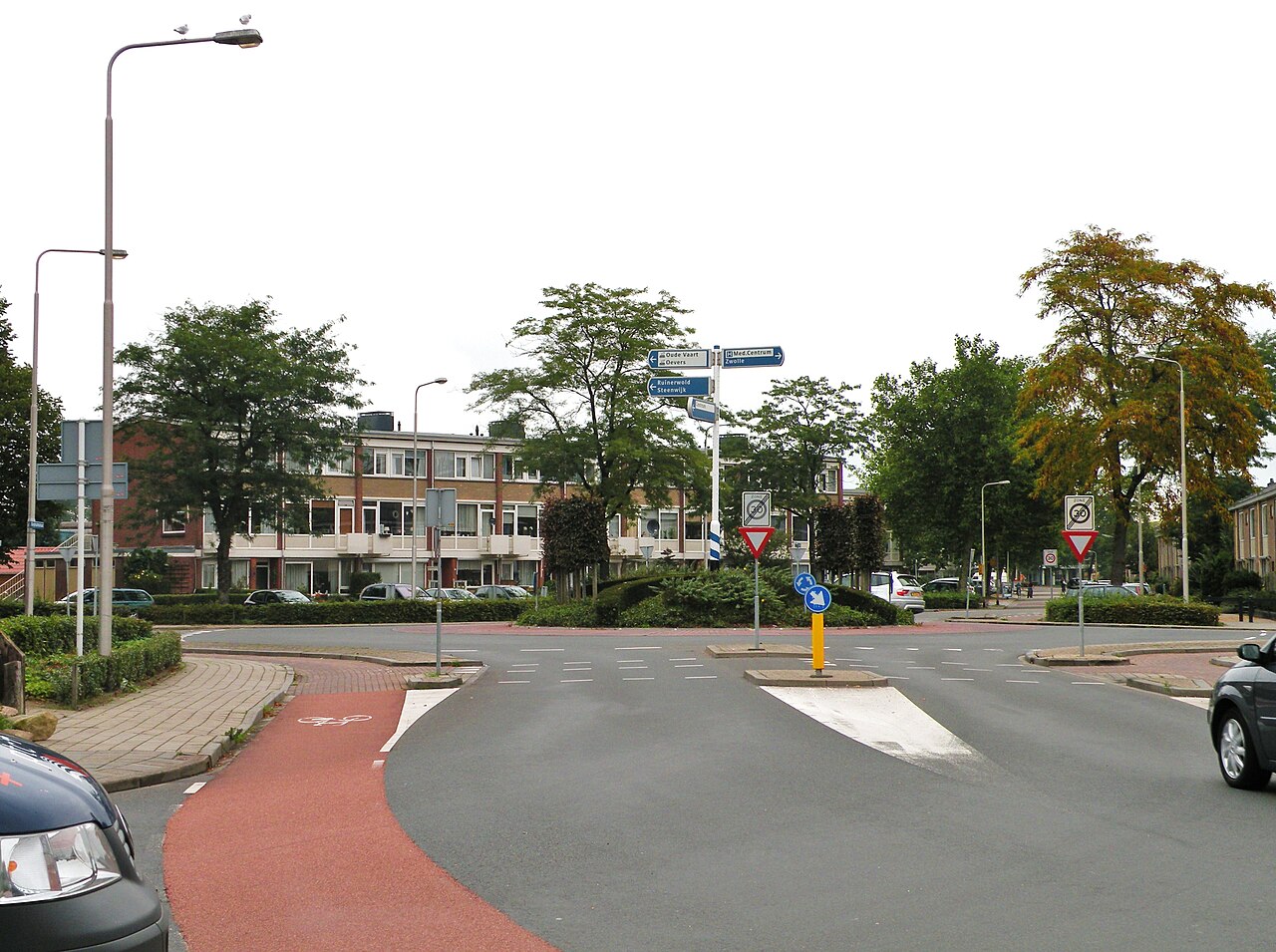
Ceintuurbaan — Meppel, Drenthe
Small townCobble apron
A modest 30 m roundabout integrated into a residential ring road — the everyday Dutch typology that gets little attention but does most of the work.
Photo: Weefemwe · Wikimedia · CC BY-SA 3.0
Where Russian practice is closest to Dutch
Government Decree N 1300 of 26 October 2017 made circulating priority the default — a change the Netherlands made twenty-six years earlier. The current rural-road standard ГОСТ Р 70555-2022 "Roundabout intersections — design rules" (active since 1 February 2023) mandates entry deflection, classifies roundabouts by diameter and forbids them on the busiest motorway categories. For urban streets, СП 396.1325800.2018 §5.8 — current with three amendments (the last in force from 27 January 2025) — sets minimum central-island diameters (10 m for one-lane, 12 m for two-lane) and the methodology for choosing the design vehicle. The Federal Road Agency recommendation ОДМ 218.2.071-2016 describes retrofit techniques for existing junctions. The gap with Dutch practice has narrowed but remains real: there is no current national standard for turbo geometry (the only such document, the preliminary standard ПНСТ 271-2018, expired on 1 September 2021 and was replaced by ГОСТ Р 70555, which omits turbo-roundabouts), and Dutch concentric cycle rings have no Russian equivalent.
Where the United Kingdom diverges
British roundabouts share the Dutch priority rule but rely on flared multi-lane entries to maximise capacity, accepting higher entry speeds. UK design also retains the signalised roundabout — practically extinct in the Netherlands — as a normal tool on motorway interchanges.


.jpg)
.jpg)
